الوصف
Water Turbidity Sensor Module (Probe + Signal Board, 5V, Analog & Digital Output)
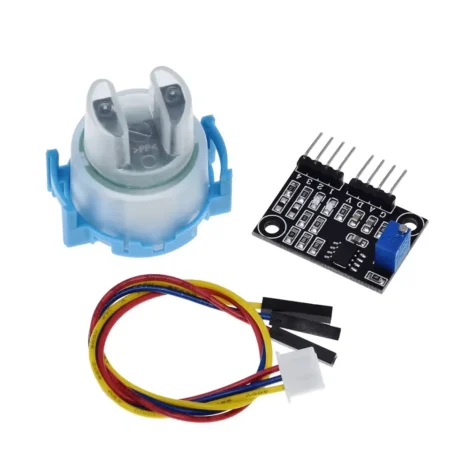
Meet the Water Turbidity Sensor Module—a compact, plug-and-play kit that combines an infrared optical probe with a conditioning board to read the clarity of water in real time. Designed around an IR emitter and a matched phototransistor, the sensor measures the light scattered by suspended particles and converts it to a clean voltage level your controller can understand. Whether you’re tracking filter performance, automating aquarium maintenance, logging environmental data, or building a classroom experiment, this module delivers repeatable results with minimal setup.
Why this module
- 🔌 Drop-in wiring: 3-wire probe into the board; board provides VCC, GND, AO (analog), DO (digital) to your microcontroller.
- ⚙️ Two outputs: Read fine-grained analog voltage for calibration or use digital threshold via an onboard comparator (potentiometer adjustable).
- 🧪 Reliable optical design: IR LED (emitter) + phototransistor geometry reduces color sensitivity and ambient-light effects for stable readings.
- 🧩 Broad compatibility: Works with Arduino, ESP32/ESP8266, STM32, Raspberry Pi (via ADC), PLCs with 0–5 V inputs, and common data loggers.
- 💧 Ready for real water: Encapsulated probe head tolerates continuous contact with water; ideal for aquariums, hydroponics, RO/DI monitoring, and lab demos.
- 🔧 Onboard trim: Set the turbidity trip point for the digital output using the multi-turn potentiometer; onboard LED indicates state at a glance.
- 📊 Calibratable response: Map voltage to NTU using your own clear/standard samples for best accuracy (application note below).
- 🧠 Noise-reduced signal chain: Low-ripple 5 V operation and analog filtering provide stable readings even with long sample tubes.
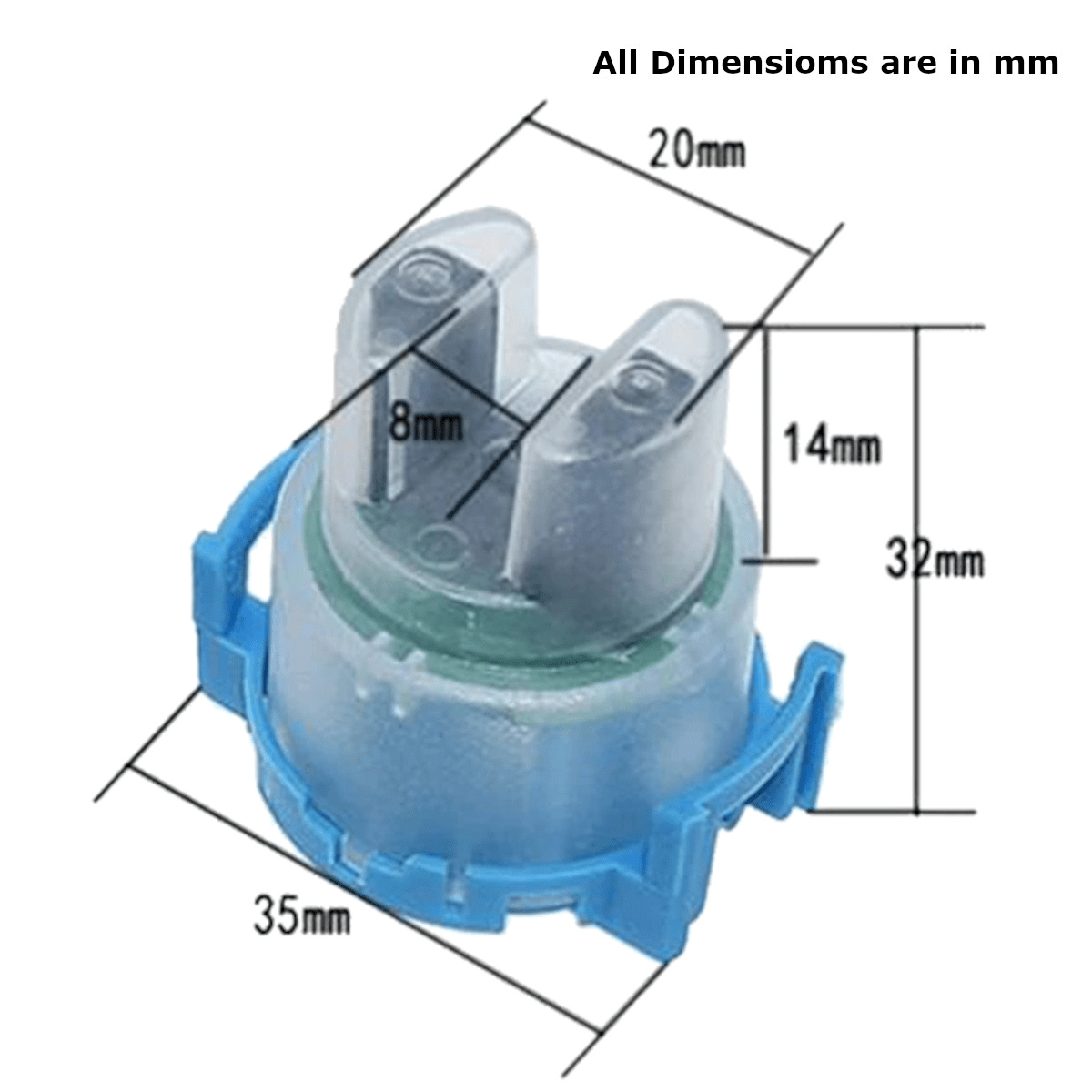
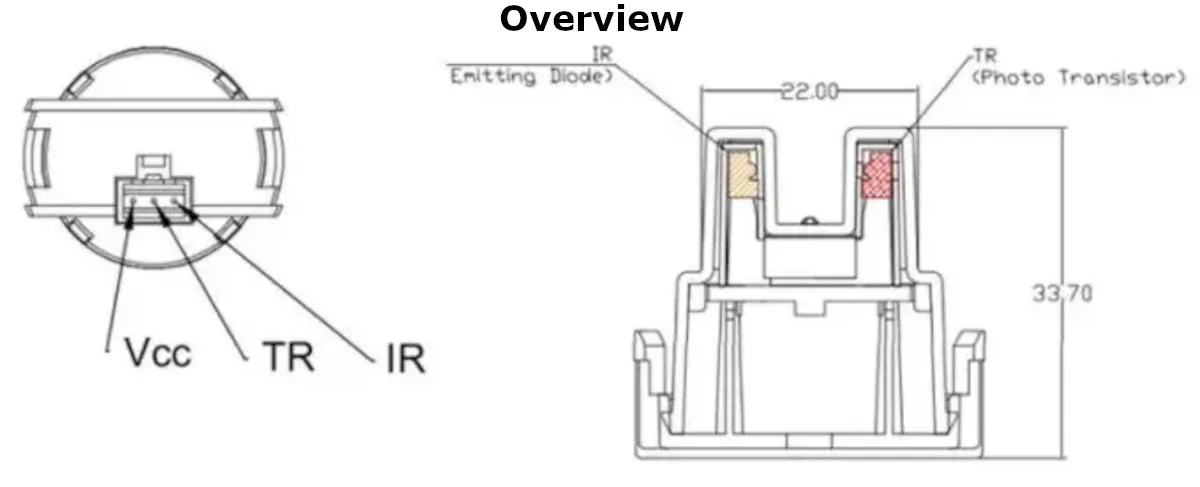
- 🧴 Compact probe: Round housing with bayonet-style collar makes panel mounting straightforward; see mechanical drawing below.
- 🧷 Fail-safe wiring labels: Probe pins are molded and labeled VCC / TR / IR on the head for easy verification during assembly.
What’s in the box
- 🧊 Optical turbidity probe (blue collar, translucent head)
- 🟦 Signal conditioning module (AO/DO outputs, trim pot, indicator LED)
- 🪢 3-core lead between probe and board (assumption: 20–30 cm; confirm as needed)
- 📄 Quick-start reference card (assumption)
How it works
- ✨ IR emission: The IR LED sends light through the water sample.
- 🛰️ Scatter collection: Suspended particles scatter light toward the phototransistor.
- 🔄 Proportional signal: More particles → more scatter → higher sensor current → a higher AO voltage (after conditioning).
- 🚦 Thresholding: The onboard comparator compares AO to your setpoint to drive DO high/low for simple on/off logic and alarms.
Typical applications
- 🐠 Aquariums & aquatic farms: filter clogging detection, water change timing
- 🥬 Hydroponics & nutrient tanks: clarity tracking after dosing
- 🚰 RO/DI systems: membrane performance monitoring
- 🧪 Education & STEM labs: optics, scattering, environmental science
- 🏭 Process water checks & coolant systems (non-hazardous fluids)
- 🌿 Environmental sampling (rivers, ponds) with portable data loggers
Mechanical overview
- 📐 Probe outer diameter: 35 mm
- 📐 Overall height: ~32 mm
- 📐 Top fork width: 20 mm
- 📐 Fork height above rim: ~14 mm
- 📐 Aperture spacing / feature width: ~8 mm
- 🧲 Mounting: Round body with locking blue collar; suitable for panel/snap fit (confirm your preferred method)
- 🧾 Internal layout: Left cavity = IR Emitting Diode; right cavity = TR (Photo-Transistor). Connector at base labeled VCC / TR / IR for the head.
Electrical & performance
- 🔋 Supply voltage (board): 5 V DC (typ. 4.5–5.5 V)
- ⚡ Current draw: ~30 mA (IR LED on)
- 📈 Analog output (AO): ~0.2–4.5 V proportional to turbidity
- 🎚️ Digital output (DO): TTL-level, active on threshold; adjustable via potentiometer
- 🎯 Recommended turbidity range: 0–1000 NTU usable; 0–3000 NTU extended with custom calibration (assumption; set by application)
- 🔁 Repeatability: good with stable temperature and supply; use averaging for best results
- 🌡️ Operating temp (probe): 5–50 °C (assumption)
- 🚿 Fluid compatibility: Freshwater; non-corrosive, non-solvent liquids. Avoid hot, viscous, or solvent media.
Pinout & wiring
Probe head → Signal board (3-wire):
- 🟥 VCC — 5 V to IR LED and board bias
- 🟡 TR — Phototransistor sense to conditioning circuit
- 🟦 IR — IR LED cathode/anode lead (as wired on board)
Signal board → Controller:
- 🔴 VCC — 5 V
- ⚫ GND — Ground
- 🟢 AO — Analog voltage (to MCU ADC)
- 🟣 DO — Digital threshold (to MCU GPIO / interrupt)
Quick start (Arduino-style)
- 🔌 Power the Water Turbidity Sensor Module at 5 V.
- 🟢 Connect AO to an analog pin (A0).
- 🟣 Optionally connect DO to a digital pin (D2) for alarm/threshold.
- 🎚️ Place the probe into your water sample; wait 3–5 s for stabilization.
- 🧭 Turn the potentiometer until the onboard LED toggles at your desired clarity.
- 📊 Read AO values, average (e.g., 10–50 samples), and map to NTU using your calibration curve.

Calibration notes (recommended)
- 🌫️ Reference points: Use clear water (0 NTU proxy) and a known turbidity standard (e.g., 100–500 NTU for your range).
- 📐 Curve fitting: Record AO for each reference; fit a 2-point linear or polynomial curve to convert AO→NTU.
- 🔁 Stability: Keep temperature, container geometry, and immersion depth consistent between measurements.
- 🧼 Maintenance: Rinse after each use; avoid fingerprints or film on the optical windows.
Safety & care
- 🚫 Not for hot liquids, solvents, or strong acids/alkalis.
- 🧯 Observe correct polarity; reverse connection may damage the IR LED.
- 🧽 Keep the optical windows clean; deposits cause drift.
- 🧊 Store dry and dust-free when not in use.
Specifications
| Category | Parameter | Value / Detail |
|---|
| Electrical | Supply Voltage (board) | 5 V DC (typ. 4.5–5.5 V) |
| Current Draw | ~30 mA (typical) |
| Analog Output (AO) | ~0.2–4.5 V proportional to turbidity |
| Digital Output (DO) | TTL, comparator with adjustable threshold |
| Output Indicators | Onboard LED for DO state |
| Optical | Emitter | Infrared diode (IR) |
| Receiver | Phototransistor (TR) |
| Mechanical (probe) | Outer Diameter | 35 mm |
| Overall Height | ~32 mm |
| Fork Width (top) | 20 mm |
| Fork Height Above Rim | ~14 mm |
| Aperture Feature | ~8 mm |
| Environment | Operating Temp | 5–50 °C (assumption) |
| Fluid Compatibility | Freshwater, non-corrosive liquids |
| Range & Performance | Recommended NTU Range | 0–1000 NTU typical (application-dependent) |
| Extended Range | Up to 3000 NTU with calibration (assumption) |
| Interfaces | Probe-to-Board Leads | 3-wire (VCC / TR / IR) |
| Board-to-Host | VCC, GND, AO, DO |
| Physical | Probe Material | Translucent head with blue locking collar |
| Cable Length | ~20–30 cm (assumption) |
| Packaging | Contents | Probe + signal board + cable |
Integration tips
- 🧰 Add a simple RC low-pass (e.g., 1 kΩ + 0.1 µF) on AO if your ADC is noisy.
- 🔋 Use a stable 5 V regulator; USB power noise can jitter readings—enable ADC averaging.
- 🧪 For inline plumbing, print a 35 mm holder with o-ring groove; avoid bubbles crossing the optical path.
- 🌊 For repeatable lab readings, use the same beaker and immersion depth; gently stir to remove micro-bubbles.
turbidity sensor, water clarity sensor, NTU sensor, IR water sensor, optical turbidity probe, analog turbidity module, water quality sensor.
حساس عكارة الماء (مسبار بصري + لوحة إشارة 5فولت بمخرج تناظري ورقمي)
يقدم حساس عكارة الماء حلاً عمليًا وسهل الدمج لقياس نقاء المياه لحظيًا. يعتمد المسبار على مصدر ضوء تحت الأحمر ومستقبل فوتوترانزستور لالتقاط الضوء المتناثر من العوالق، ثم تُحوَّل الإشارة إلى جهد مستقر جاهز للقراءة بواسطة أي متحكم. من أحواض الأسماك والأنظمة المائية إلى المختبرات والتعليم، يوفر هذا الطقم نتائج متسقة بإعدادات بسيطة.
- 🔌 توصيل مباشر: كابل ثلاثي بين المسبار واللوحة، واللوحة تعطيك VCC وGND وAO التناظري وDO الرقمي.
- ⚙️ مخرجان للاستخدامات المختلفة: قراءة تناظرية دقيقة للمعايرة، أو إشارة رقمية بالعتبة القابلة للضبط عبر المقاومة المتغيرة.
- 🧪 تصميم بصري موثوق: باعث تحت الأحمر + فوتوترانزستور يقللان تأثير لون الماء والإضاءة المحيطة.
- 🧩 توافق واسع: يعمل مع Arduino وESP32/ESP8266 وRaspberry Pi (مع محول ADC) وأنظمة التحكم الصناعية ذات مدخل 0–5 فولت.
- 💧 مناسب للماء الفعلي: رأس مغلف للاستخدام المستمر داخل الماء—مثالي للأحواض، والهيدروبونيك، ومراقبة RO/DI، والتجارب.
- 🔧 ضبط سريع: حد العتبة للمخرج الرقمي DO يتم بواسطة مقاومة متغيرة؛ وLED على اللوحة يوضح الحالة.
- 📊 قابل للمعايرة: اربط الجهد التناظري بقيم NTU باستخدام عينات مرجعية لتحصل على دقة عالية.
- 🧠 سلسلة إشارة منخفضة الضجيج: تشغيل 5 فولت مع ترشيح تناظري لمنع التذبذب.
- 🧴 أبعاد عملية: جسم دائري مع طوق قفل أزرق لسهولة التثبيت؛ راجع الأبعاد أدناه.
- 🧷 وسوم توصيل واضحة: أطراف المسبار موسومة VCC / TR / IR لتفادي الأخطاء.
الاستخدامات المقترحة
- 🐠 أحواض الأسماك والأنظمة المائية: توقيت تغيير المياه، كشف انسداد الفلاتر
- 🥬 الزراعة المائية: متابعة نقاء المحلول بعد الإضافة
- 🚰 أنظمة RO/DI: تتبع أداء الأغشية
- 🧪 التعليم والمختبرات: دروس البصريات والبيئة
- 🏭 فحوصات المياه الصناعية غير الخطرة
- 🌿 أخذ عينات بيئية مع مسجلات بيانات محمولة
الأبعاد الميكانيكية
- 📐 قطر خارجي للمسبار: 35 مم
- 📐 الارتفاع الكلي: ≈32 مم
- 📐 عرض الشُقّ العلوي: 20 مم
- 📐 ارتفاع الشُقّ فوق الحافة: ≈14 مم
- 📐 عرض فتحة داخلية: ≈8 مم
- 🧲 التثبيت: جسم أسطواني مع طوق قفل أزرق يناسب التثبيت اللوحي/السنابي
- 🧾 التوزيع الداخلي: اليسار باعث IR، اليمين TR فوتوترانزستور، والقاعدة موسومة VCC / TR / IR
المواصفات الكهربائية والأداء
- 🔋 جهد التشغيل: 5 فولت DC (4.5–5.5 فولت)
- ⚡ الاستهلاك: ~30 ملي أمبير
- 📈 المخرج التناظري AO: حوالي 0.2–4.5 فولت متناسب مع العكارة
- 🎚️ المخرج الرقمي DO: مستوى TTL مع عتبة قابلة للضبط
- 🎯 المجال المقترح للعكارة: 0–1000 NTU (قابل للتوسعة بالمعايرة حتى ~3000 NTU)
- 🌡️ درجة الحرارة التشغيلية: 5–50 °م (افتراض)
- 🚿 توافق السوائل: مياه عذبة وسوائل غير مُذبذِبة أو غير مُذيبة
مخطط التوصيل
من المسبار إلى اللوحة (3 أسلاك):
- 🟥 VCC — تغذية 5 فولت للباعث والدوائر
- 🟡 TR — إشارة الفوتوترانزستور إلى دائرة التكييف
- 🟦 IR — طرف باعث تحت الأحمر
من اللوحة إلى المتحكم:
- 🔴 VCC — 5 فولت
- ⚫ GND — أرضي
- 🟢 AO — جهد تناظري إلى دخل ADC
- 🟣 DO — خرج رقمي يعتمد على العتبة
البدء السريع
- وصل 5 فولت وGND إلى اللوحة.
- صِل AO بمدخل تناظري في المتحكم وDO بمدخل رقمي عند الحاجة.
- اغمر رأس الحساس في العينة وانتظر ثوانٍ للاستقرار.
- عدّل المقاومة المتغيرة حتى تتغير إضاءة LED عند مستوى العكارة المطلوب.
- استخدم متوسط قراءات متعددة لبناء منحنى تحويل AO → NTU.
العناية والسلامة
- تجنب السوائل الساخنة أو المذيبات أو الأحماض/القواعد القوية.
- التوصيل العكسي قد يتلف باعث IR.
- حافظ على نظافة نوافذ المسبار.
- خزّن الحساس جافًا ونظيفًا.
جدول المواصفات
| الفئة | البند | القيمة / التفاصيل |
|---|
| كهربائي | جهد التشغيل | 5 فولت DC (4.5–5.5 فولت) |
| الاستهلاك | ~30 ملي أمبير |
| المخرج التناظري AO | ~0.2–4.5 فولت |
| المخرج الرقمي DO | TTL مع عتبة قابلة للضبط |
| بصري | الباعث | LED تحت الأحمر |
| المستقبل | فوتوترانزستور |
| ميكانيكي (المسبار) | القطر الخارجي | 35 مم |
| الارتفاع الكلي | ≈32 مم |
| عرض الشق العلوي | 20 مم |
| ارتفاع الشق فوق الحافة | ≈14 مم |
| عرض فتحة داخلية | ≈8 مم |
| بيئة | درجة الحرارة | 5–50 °م (افتراض) |
| توافق السوائل | مياه عذبة وسوائل غير مؤذية |
| الأداء | مجال NTU المقترح | 0–1000 NTU (قابل للتوسعة بالمعايرة) |
| الواجهات | كابل المسبار | 3 أسلاك (VCC/TR/IR) |
| توصيل اللوحة | VCC وGND وAO وDO |
| فيزيائي | المادة | رأس شفاف مع طوق أزرق |
| التغليف | المحتويات | مسبار + لوحة + كابل |
نصائح للدمج
- استخدم ترشيحًا بسيطًا على AO إن لزم (RC صغير).
- وفّر تغذية مستقرة 5 فولت لتقليل التموج والضجيج.
- تجنب الفقاعات والاتساخ أمام النوافذ البصرية.
- ثبّت العمق والحاوية لقياسات قابلة للتكرار.
حساس عكارة، مقياس NTU، حساس صفاء الماء، حساس بصري للماء، وحدة عكارة تناظرية.
| | |
|---|
| DFRobot SEN0189, Gravity Turbidity, Keyestudio KS0315, Generic SKU: 8028, HW-TURBID | water clarity sensor, NTU meter, IR turbidity, suspended solids sensor, water quality module, analog turbidity, digital turbidity, 5V optical sensor | turbidity probe, NTU sensor, optical water sensor, turbidity detector, turbidity measurement module |