

MOSFET Transistors
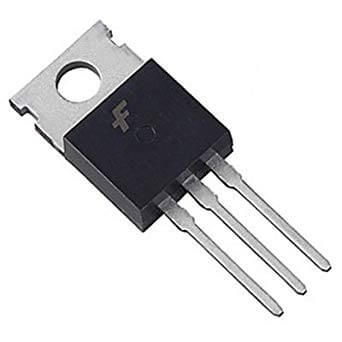
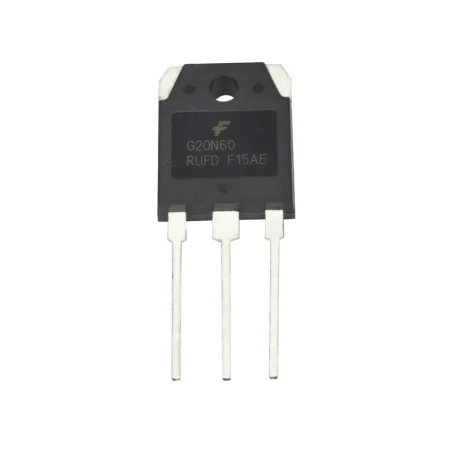
IRF540N N-Channel MOSFET TRANSISTOR 100V 0.044Ω 33A TO-220
Original price was: 25.00 EGP.18.00 EGPCurrent price is: 18.00 EGP.
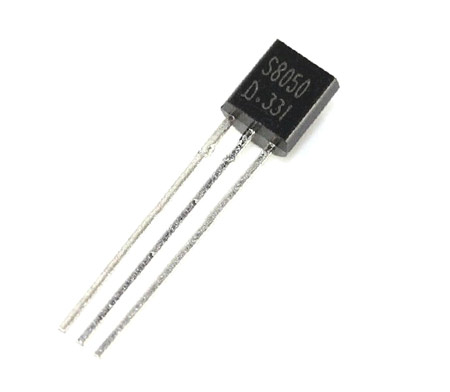
| Pin Number | Pin Name | Description |
| 1 | Emitter | Current Drains out through emitter |
| 2 | Base | Controls the biasing of transistor |
| 3 | Collector | Current flows in through collector |
Note: Complete Technical Details can be found in the S8050 datasheet given at the end of this page.
S9014,MPSA42, SS8050, BC547, 2N2369, 2N3055, 2N3904, 2N3906
2N5830, S9013
S8050 is a NPN transistor hence the collector and emitter will be left open (Reverse biased) when the base pin is held at ground and will be closed (Forward biased) when a signal is provided to base pin. It has a maximum gain value of 400; this value determines the amplification capacity of the transistor normally S8050. Since it is very high it is normally used for amplification purposes. However at a normal operating collector current the typical value of gain will be 110. The maximum amount of current that could flow through the Collector pin is 700mA, hence we cannot drive loads that consume more than 700mA using this transistor. To bias a transistor we have to supply current to base pin, this current (IB) should be limited to 5mA.
When this transistor is fully biased then it can allow a maximum of 700mA to flow across the collector and emitter. This stage is called Saturation Region and the typical voltage allowed across the Collector-Emitter (VCE) or Collector-Base (VCB) could be 20V and 30V respectively. When base current is removed the transistor becomes fully off, this stage is called as the Cut-off Region.
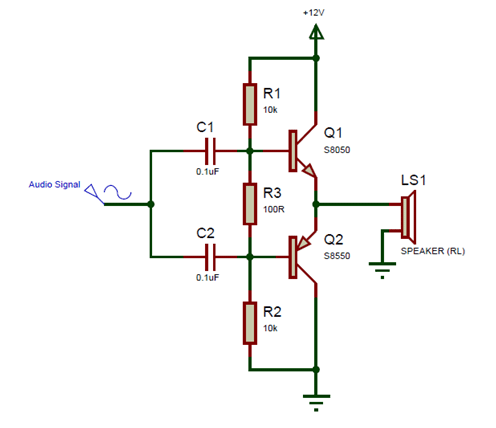
As mentioned in the features of the S8050 transistor is commonly used in push pull configuration with Class B amplifier. So let us discuss how that is done.
A push pull amplifier, commonly known as Class B amplifier is type of multistage amplifier commonly used for audio amplification of loudspeakers. It is very simple to construct and requires two identical complimentary transistors operate. By complimentary it means that we need a NPN transistor and its equivalent PNP transistor. Like here the NPN transistor will be S8050 and its equivalent PNP transistor will be S8550. A simple circuit diagram of the Class B amplifier with the using the S8050 is shown below.
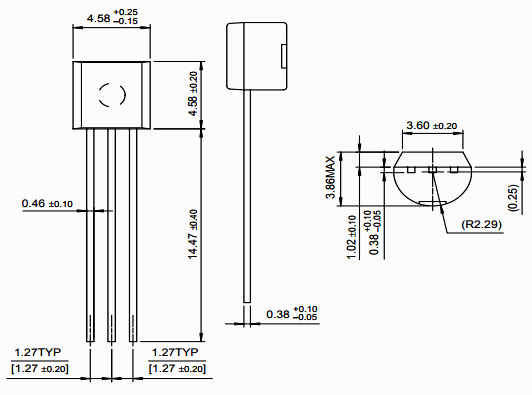
If you are designing a PCB or Perf board with this component then the following picture from the S8050 transistor Datasheet will be useful to know its package type and dimensions.






Tell us what you are building and we will help you find suitable components, modules, development boards and tools from our available range.